
Practical resume tips for resumes, applications, and landing the role.
Short, opinionated resume tips for people actively job hunting - from writing your first bullet to negotiating a senior offer.
 Resume Writing
How to write a resume summary that actually gets interviews
A great summary is not a personal mission statement. It is a three-line argument for why you are worth a 30-minute call. Here is how to write one that earns the interview.
 ATS & Strategy
ATS keywords: the complete guide for job seekers
Applicant tracking systems are less mysterious - and less sinister - than the internet pretends. Here is what actually matters, and how to write a resume that lines up cleanly with the role.
 Resume Writing
Writing achievement bullets that prove impact (not just duties)
The gap between an average resume and a strong one usually comes down to bullets. Here is how to rewrite each line so it leads with outcome instead of activity.
 Resume Writing
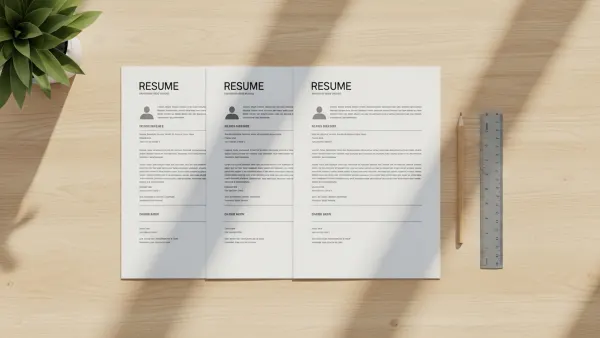
Resume structure: the sections every resume needs (and the ones it doesn't)
A resume is not a single template - it is a small set of decisions about ordering and emphasis. Here is the structure that works for almost every career stage.
 Applications
Cover letters that actually get read
Cover letters are not dead - bad cover letters are. A short, specific, well-aimed letter still moves applications forward when used in the right places.
 Early Career
Resume tips for first-time job seekers
You have less work history to draw on, but that does not mean you have less material. A first-time resume just rearranges what counts as experience.
 Career Change
Career change resume: how to tell a new story without lying
Switching industries does not mean reinventing yourself on paper. It means re-framing what you have already done so it lines up cleanly with where you want to go next.
 Applications
LinkedIn and resume alignment: getting them to tell the same story
Recruiters compare your LinkedIn and your resume side by side. Subtle mismatches cost you credibility. Here is how to keep both documents honest without duplicating your work three times a year.
 Applications
Tailoring your resume to each job posting (without rewriting it from scratch)
You do not need a custom resume for every application. You need a strong base resume and a disciplined twenty-minute tailoring pass.
 Resume Writing
Resume mistakes that get you eliminated before the interview
Some resume mistakes are stylistic; some are fatal. Here are the ones that quietly take you out of the running before any human reads your bullets in detail.
 Resume Writing
How to handle employment gaps on your resume
Gaps in employment are normal and increasingly expected. The mistake is not having one - the mistake is trying to hide it badly. Here is how to address gaps directly.
 Resume Writing
Quantifying impact: numbers that prove your value (without making them up)
Numbers make resume bullets credible. But invented metrics do more damage than a missing one. Here is how to find honest numbers in work you already did.
 Interviewing
Interview preparation: the questions worth rehearsing in detail
You do not need to memorize answers to fifty questions. You need to have crisp, honest answers to a small handful that almost always come up.
 Offer & Negotiation
Salary negotiation tactics that work after the offer arrives
Negotiating after the offer is normal, expected, and almost always less awkward than candidates fear. Here is how to do it without giving up your leverage.
 Job Search
Remote job search strategies for the modern market
Remote roles are more competitive, more global, and more selective than they were three years ago. Here is how to run a serious remote-first job search.